


Table of Contents
- What is Customer Lifetime Value (CLV)
- CLV in Ecommerce: Why It’s a Crucial Metric
- Customer Lifetime Value Calculator: Tools and Techniques
- Importance of Customer Lifetime Value in Ecommerce
- Understanding CLV Metrics
- Common Mistakes in CLV Calculation
- How to Improve Low CLV
- Strategies to Maximize Customer Lifetime Value
- Final Takeaways
- FAQs
Why should you care about just one customer in your ecommerce business? Think about how much money that person could bring in over the years.
Customer Lifetime Value, or CLV, helps you figure this out. We’re not just talking about a single purchase here. CLV tallies the total cash a customer is likely to drop over the entire time they shop with you. For anyone involved in ecommerce, getting a handle on CLV can really shake things up.
Business owners learn how much to invest in customer acquisition and retention. Marketing teams can tailor strategies to target high-value customers. Even customers benefit as companies strive to offer better products and services to keep them engaged.
So, in the ecommerce world, knowing CLV’s significance isn’t just helpful; it’s essential.
What is Customer Lifetime Value (CLV)
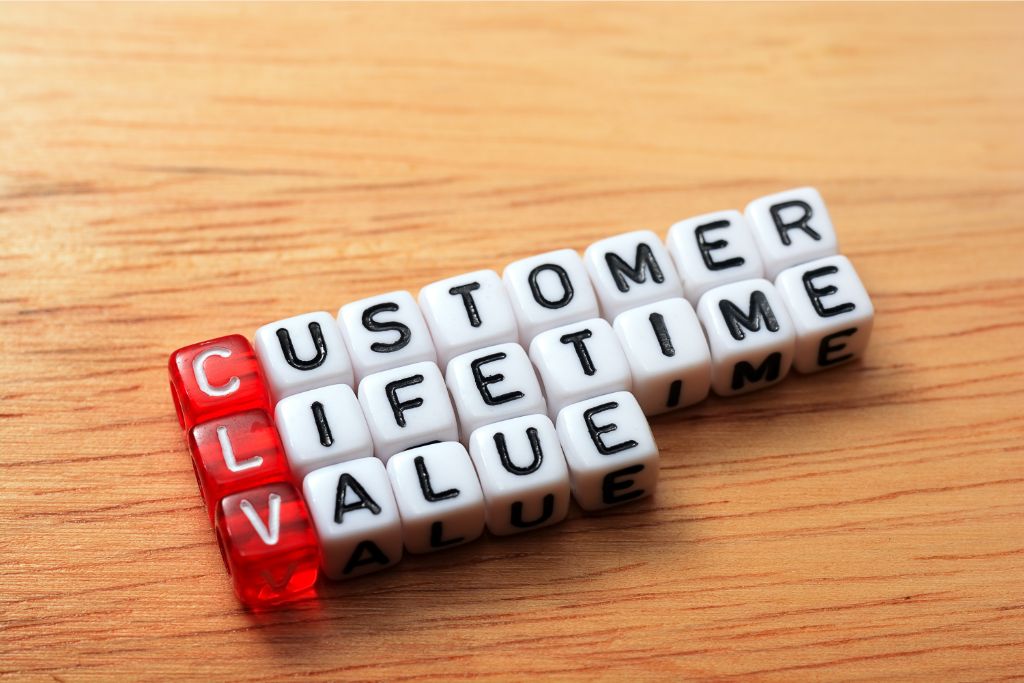
Ever wonder how much money one customer brings to an online store over time? That’s what Customer Lifetime Value (CLV) helps you figure out.
In your ecommerce business, CLV sums up the cash a customer will probably drop over their whole relationship with you. It’s not a one-and-done deal; it’s a tally of multiple buys.
Understanding CLV guides your growth strategy. It clues you in on how much to shell out for ads or special deals to snag and keep customers. So, instead of just hunting for fast bucks, you’re laying the groundwork for a business that lasts.
CLV acts as a health check for your business. A rising CLV can mean your business is doing well and customers like your offering. On the flip side, dropping CLV can be a red flag. It might mean customers are not happy or that they’re finding better deals elsewhere. Either way, watching CLV helps you spot problems early and keep your business on track for the long haul.
CLV in Ecommerce: Why It’s a Crucial Metric
Why does CLV matter so much in ecommerce? CLV serves as a crystal ball for your business’s future. It sizes up a customer’s worth throughout their entire journey with your store. Ignoring CLV? Then you’re navigating without a map, making long-term planning a shot in the dark.
Let’s dive into the roles CLV plays in your business. First, it helps you find the right product-market fit. If your CLV is high, customers like your products and keep returning for more. That’s a good sign you’re meeting their needs.
Second, a strong CLV often points to solid brand loyalty. Customers aren’t just making one-time purchases; they’re sticking around.
Lastly, CLV is a big deal for recurring revenue. A high CLV means you can count on a steady income stream from loyal customers, making it easier to grow your business.
How much should the CLV be for an ecommerce brand? It differs based on your sector of the economy and business practices. The worth of the top 1% of ecommerce customers, however, can soar to 18 times that of an average client, per to RJMetrics analysis. That stark difference demonstrates the value of concentrating on CLV.
Customer Lifetime Value Calculator: Tools and Techniques
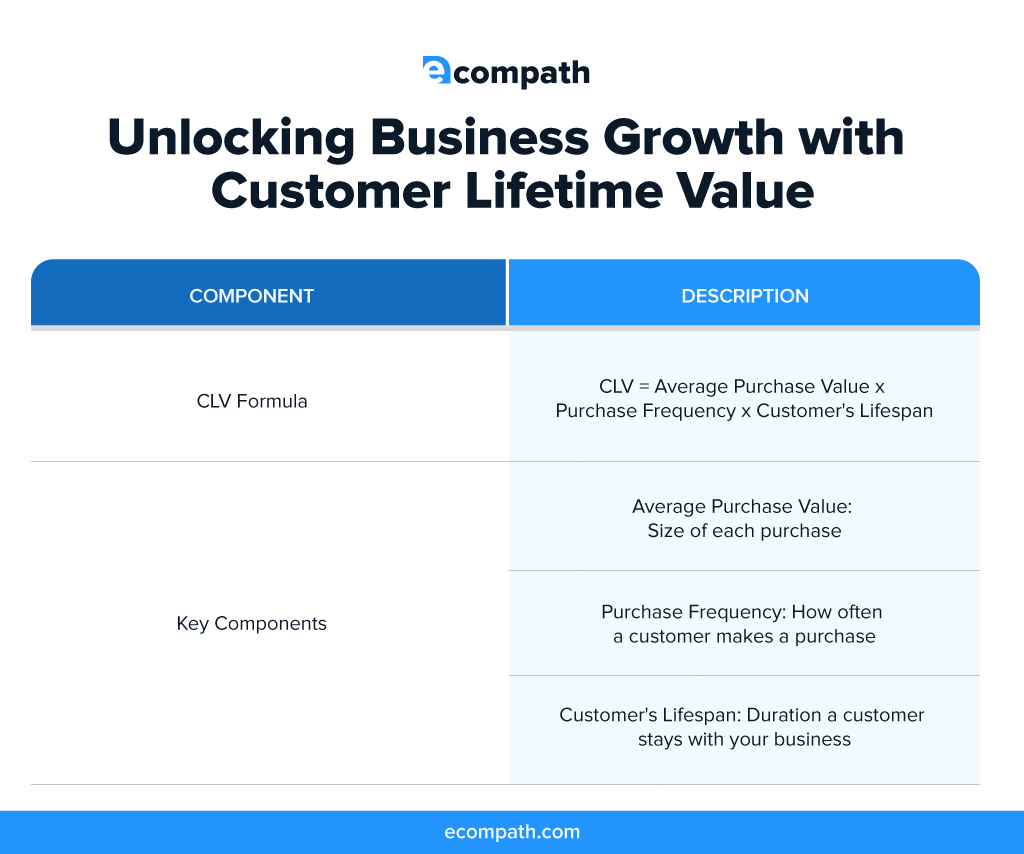
Want to figure out your CLV? You’ll need a formula. The basic CLV formula multiplies the average purchase value by the purchase frequency and the customer’s lifespan. To put it plainly, you look at three things: each purchase’s size, shopping frequency, and the customer’s lifespan. Combine these, and you’ve got a solid gauge of long-term customer value.
When it comes to crunching these numbers, two popular approaches stand out: the Accumulated Data Method and the Average Estimate Method. The Accumulated Data Method uses real numbers from your past sales. You look at what each customer has spent over time.
The Average Estimate Method, on the other hand, uses averages. You get a rough estimate by averaging the spend and the number of buys. Each method has its ups and downs, so testing both could give you a fuller picture.
Don’t forget, analytics tools are key players in making this happen. They can pull all your historical data, like past purchases and customer behaviors. With this data, the tools can give you a pretty accurate CLV. They can even break it down by customer segments, showing you which types of customers are most valuable.
So, if you’re serious about understanding your CLV, investing in good analytics tools is a smart move.
Importance of Customer Lifetime Value in Ecommerce
CLV acts like your business’s future-telling crystal ball in the ecommerce world. It clues you in on a customer’s long-term value, guiding your investment choices.
When you see a high CLV, chances are your business is set for lasting success. On the other hand, a low CLV could signal trouble, urging you to reevaluate your strategies.
Brand Loyalty
Brand loyalty isn’t just a buzzword; it’s the backbone of ecommerce success. Customers who keep coming back often feel a strong connection to your brand. CLV helps you measure this loyalty by tracking how much these customers spend over time.
By focusing on increasing the CLV of your most loyal customers, you’re essentially nurturing a relationship that’s already strong, making it even stronger.
Product-Market Fit
First, get to know the parts that make up CLV: Customer Value, Average Purchase Value, Purchase Frequency, and Customer Lifespan. Combine these by multiplying, and you’ve got a reliable gauge of what a customer is worth over time.
You’ve got a couple of options for tackling this math. The first uses accumulated data, pulling from actual sales records to get precise numbers. The second uses average estimates, giving you a general idea based on broader data.
Recurring Revenue
Recurring revenue serves as your ecommerce business’s steady pulse, with funds flowing in regularly from devoted customers. CLV calculations play a key role in fine-tuning this aspect.
CLV insights shape your customer retention game plan, whether you’re running a subscription service or just enjoy a fiercely loyal following. This metric shows you the spending leeway you have to keep a customer around and the future earnings you can anticipate from them. Plus, a strong CLV often signals a healthy, sustainable business. It also helps you identify which customers are most valuable so you can focus your efforts effectively.
Understanding CLV Metrics
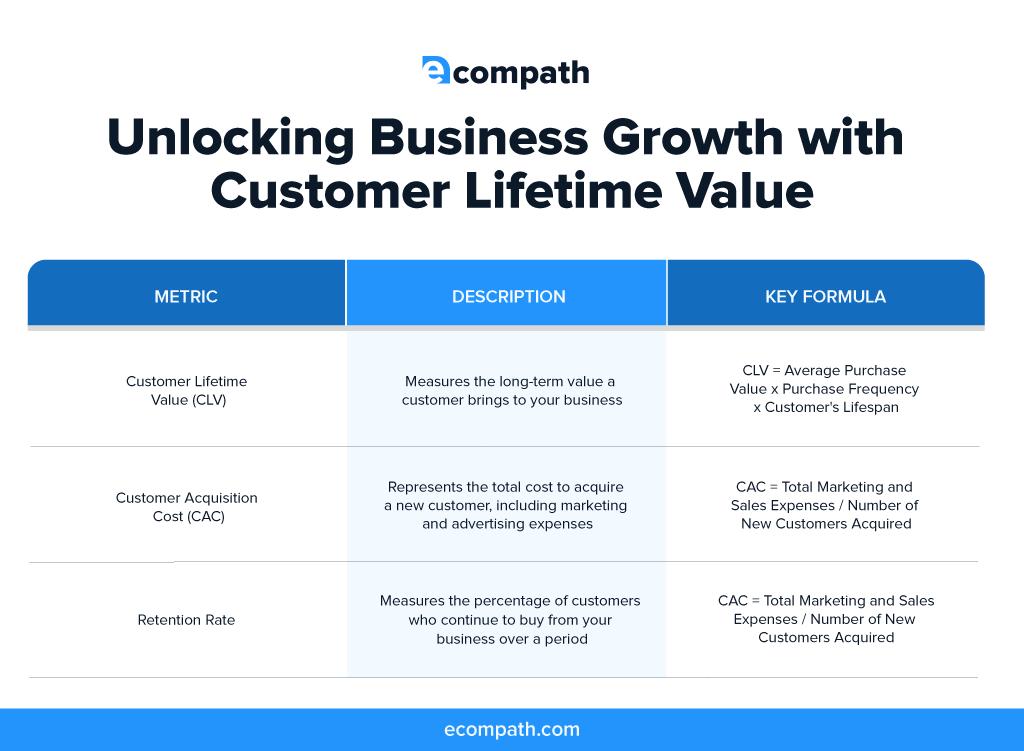
Let’s dive deeper into the metrics closely related to Customer Lifetime Value (CLV). Customer Acquisition Cost (CAC), Retention Rate, and Average Order Value (AOV) are the metrics in play here. Grasping these gives you a 360-degree view of both your business health and customer behavior.
Customer Acquisition Cost (CAC)
CAC is the total cost of convincing a potential customer to make a purchase. This includes marketing expenses, advertising, and other costs of gaining new customers.
The goal is to keep this cost as low as possible while maximizing the value you get from each customer (CLV). If your CAC is high, but your CLV is low, you’re losing money in the long run. On the other hand, a low CAC and a high CLV means you’re getting a great return on your investment.
Retention Rate
The retention rate measures how many customers continue to buy from you over a certain period. This is crucial because retaining customers usually costs less than acquiring new ones.
A high retention rate often indicates customer satisfaction and can lead to increased CLV. To figure out the retention rate, first count how many customers you have at the end of a given time frame. Next, subtract any new faces you’ve gained. Divide that number by your customer count at the period’s start. Finally, make it a percentage by multiplying by 100.
Average Order Value (AOV)
AOV represents the average amount of money a customer spends during a single transaction with your business. To calculate it, divide the total revenue by the number of orders. Increasing your AOV can have a direct impact on your CLV.
Strategies to boost AOV include offering bundle deals, free shipping on orders over a certain amount, or discounts on additional items. By encouraging customers to spend more each time they shop, you’re increasing your immediate revenue and raising your CLV.
Common Mistakes in CLV Calculation
Here are some common errors businesses make when calculating CLV and tips on how to avoid them.
Using Incomplete Data
One big mistake in calculating CLV is not using all your data. Some businesses only look at recent transactions, which can give a skewed picture.
For a more accurate CLV, include all transactions from the customer’s entire history with your business. This way, you capture seasonal trends, special promotions, and other factors that could affect CLV.
Ignoring Customer Segments
Another error is treating all customers as if they’re the same. Different groups of customers can have vastly different CLVs. For example, a teenager shopping for trendy clothes might have a lower CLV than a parent buying baby supplies.
By segmenting customers based on behavior, demographics, or purchase history, you can calculate more accurate CLVs. This also allows you to tailor marketing strategies to different segments.
How to Improve Low CLV
Here’s a practical guide for businesses with a low CLV, with actionable steps to improve it.
Enhance Customer Service
Customer service plays a huge role in whether a customer comes back. If you offer excellent service, you’re more likely to turn a one-time buyer into a loyal customer. Consider adding features like a 24/7 live chat or a detailed FAQ section on your website. Loyalty programs that reward repeat purchases can also boost CLV.
Revise Pricing Strategies
Your pricing strategy can make or break your CLV. High prices could send repeat customers running. But go too low, and you’re eating into your profits. Why not experiment with pricing strategies? Bundle deals and tiered pricing could hit the sweet spot with your customers. Keep an eye on metrics like Average Order Value (AOV) to see how these changes affect your CLV.
Strategies to Maximize Customer Lifetime Value
Increasing Customer Lifetime Value (CLV) is a strategy, not merely a goal. To get the most out of each consumer, you must concentrate on a few crucial areas. Let’s start now.
Personalized Marketing and Recommendations
Customer segmentation lets you tailor your marketing to different groups. For example, if you know a segment often buys pet supplies, send them targeted emails with special offers on dog food or cat toys.
Dynamic content on your website can also change based on a customer’s past behavior, showing them products they’re more likely to buy. This personalization keeps customers engaged and encourages them to make repeat purchases.
Enhance Customer Support and Service
Happy customers stick around. Value-added services, like personalized recommendations, loyalty programs, and exclusive content, can make a big difference. For instance, a loyalty program offering points for each purchase can keep customers returning. Exceptional customer support, like a 24/7 help chat, can build lasting relationships and boost your CLV.
Implement Cross-Selling and Upselling Techniques
Cross-selling and upselling can make each sale more profitable. Let’s say you sell laptops. When someone buys one, you could suggest a laptop bag or an extended warranty. Amazon does this well with its “Customers who bought this also bought…” feature.
These techniques increase the order value and make the customer see more value in shopping with you, thus increasing CLV.
Offer Exceptional Post-Purchase Support and Follow-Up
The sale isn’t the end; it’s just the beginning. Offering great post-purchase support can turn a one-time buyer into a loyal customer. Services like order tracking, installation guidance, and troubleshooting can make a customer’s life easier. By showing that you care about their satisfaction even after they’ve paid, you’re setting the stage for a long-term relationship.
Final Takeaways
Repeat customers are invaluable, offering steady income at a lower cost than acquiring new ones. Calculating Customer Lifetime Value (CLV) is crucial for business owners, acting as a roadmap for future success. A high CLV indicates a healthy business, while a low CLV signals the need for improvements. Understanding this metric is essential for business sustainability.
FAQs
How is Customer Lifetime Value Determined?
You calculate Customer Lifetime Value by multiplying the average purchase value by the purchase frequency and the customer’s lifespan.
What is Customer Lifetime Value and Why is It Important?
Customer Lifetime Value (CLV) is the total amount a customer will spend at your store over time. It’s crucial for planning long-term business strategies.
What is a Customer Lifetime Value in Business Example?
If customers spend $50 per month at your store and stay for two years, their CLV would be $1,200.
What is the Difference Between Customer Value and Customer Lifetime Value?
Customer Value focuses on a single transaction, while Customer Lifetime Value considers the entire relationship with the customer.
What are the Factors Affecting Customer Lifetime Value?
Purchase frequency, average spend, and customer lifespan are vital factors that impact CLV.